The Evolution of G.I. Joe

I had this vague memory of reading something about an academic study of G.I. Joe figures–by researchers from UMass and Harvard Med, by the way–which found that

the figures have grown much more muscular over time, with many contemporary figures far exceeding the muscularity of even the largest male bodybuilders…

our observations appear to represent a “male analog” of earlier studies examining female dolls such as Barbie.

Together, these studies of children’s toys suggest that cultural expectations may contribute to body image disorders in both sexes.

{You can read the full text of the academic paper here.}

I’ve written some about ‘manorexia’ before, but there’s a need for continued awareness. Because while many of us are aware that playing with Barbies can adversely affect girls’ body satisfaction, we’re less aware that

Even boys too young to have seen Schwarzenegger in The Terminator [play] with action figures. G.I. Joe, who had no abdominal muscles when the toy was first manufactured in 1963, first got some definition in 1975. By 1994, he had the muscles of a professional bodybuilder. {Read all of Ava Feuer’s excellent piece here.}

Now for the pictures, gleaned from here and there around the interwebz. Pay attention not just to the figures themselves but also how they’re portrayed on the packaging:

1960s Joe

and his package:

1970s Joe

1990s Joe

1990s Joe

2000s Joe

And just to compare next to each other: 2010 Joe is a freakishly large & muscular bodybuilder; 1960s Joe is, well, an ordinary Joe. Like most of the people serving in the Armed Forces.

1960s Joe

and a composite shot from the study...

My boys have a genetic makeup–including but not limited to a genetic disorder–that guarantees they’ll never, never, not-ever be muscular. It won’t happen, not with weightlifting, creatine, and God-knows-what-else.

But even if they could beef up, I’d hate for them to do it based on these insane cultural pressures.

That some people insanely defend as Christian values, God help us.

Boys deserve better.

{You may also like the other posts in this series-of-sorts: The Evolution of the Morton Salt Girl and The Evolution of Candy Land}

We Don’t Approve of Bull-Baiting, Dogfighting, or Public Executions…

…and so I don’t think we approve of…

Chickens being occasionally decapitated by the automatic feeding cart, then rotting away in their cages.

Chickens getting their necks stuck in the bars of their cages and dying because they can’t get them out and no one comes to help.

Workers must blast exhaust fans and run in to do a job quickly because “it’s physically hard to breathe because of the ammonia” fumes rising from the manure pits below the barns.

Conveyor belts transporting 4.5 million eggs a day–destined for places like Shop-Rite–are thick with flies, mice, and poop.

it’s just that we don’t know that this is happening…

The Humane Society of the United States recently ran an undercover investigation of Kreider Farms, finding these acts of cruelty that go against the industry standards promoted by groups like United Egg Producers, who, last year, joined with the Humane Society to support new federal standards providing more space for laying hens–a move Kreider has not supported.

In a great op-ed last week, Nicholas Kristof (one of my favorite journalists) writes:

For those who are wavering, think for a moment about the arc of empathy. Centuries ago, we humans amused ourselves by seeing other people executed or tortured. Until modern times, we considered it sport to see animals die horrible deaths. Now our sensibilities have evolved so that there is an outcry when animals are abused — unless it happens out of sight on farms.

Look, you don’t need to love chickens enough to want to hug them to realize that if God notices the death of each little sparrow, God certainly sees the suffering of the chickens who die so that we can have cheap eggs.

It isn’t only about how much we love animals. It’s about what kind of people we are going to be.

No one thinks what Michael Vick did to all those poor dogs is okay.

Chickens might be less emotionally affecting than dogs, but they’re still God’s creatures.

Why not make a brief, polite phone call to your U.S. Representative and urge them to co-sponsor H.R. 3798? Then, make a brief, polite call to your two U.S. senators to support this legislation when it’s introduced in the Senate. Look up your legislators’ phone numbers here.

“The righteous know the needs of their animals,
but the mercy of the wicked is cruel.” (Prov. 12:10)

Please don’t think this is only for crazy chicken-huggers. Take a minute to watch the video, maybe read Kristof’s op-ed, and think of the arc of empathy:

what kind of people do we want to be?

what kind of people are we made to be?

Whining about Writing, Writing about Whining

May I whine for a moment, please?

I shouldn’t pay attention to my stats, I know that. I shouldn’t even look at them, because I will write what I’m going to write no matter how popular or unpopular that’s going to be. One of my favorite authors, Beverly Cleary (yes, the creator of Ramona!) early decided that she

“would ignore all the trends…and would not let money influence any decisions about my books.”

Sage advice from one of the most popular and acclaimed children’s book authors of the 20th century!

Ready for my whine?

Posts about hunger and poverty are far less popular than posts about, say, Audrey Hepburn or Victoria’s Secret Angels.

Or, for that matter, posts pointing a finger at what’s wrong within evangelicalism.

I don’t think it’s because people don’t care about poverty, or hunger, or preventable disease, or fair trade.

I think it’s because we feel powerless and/or desensitized.

But we’re not powerless. Nor should we let ourselves be desensitized.

Two readers shared snippets of poetry that relate to this:

First, via Joyce, Audre Lord:

“How much of this truth can I bear/ to see/ and still live/ unblinded?/ How much of this pain can I use?”

Second, via Ellen, Wendell Berry:

“Expect the end of the world./Laugh./Laughter is immeasurable./Be joyful though you have considered all the facts.”

I love these.

And so I propose to try to ignore all trends, all stats.

I just wish that the 15 children who died of preventable disease while you read this post would get a fraction of the attention that goes to Mark Driscoll, Lady Gaga, or Madonna’s Halftime show.

Know what I mean?


How Sweet It Is! Feeling Better about Hershey.

You kind of have to hand it to Americans. We can turn anything into a reason for consumption. The journey from a day honoring early Christian martyrs to the World’s Largest Inflatable Heart is by no means direct.

But whatever. Chocolate is yummy.

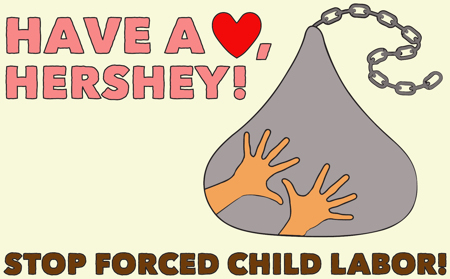
Anyway, I wanted to take this Valentine’s Day to remind you of the problem of child slavery on cocoa plantations. It’s real. It’s bad. But encouraging signs are appearing…

Hershey’s recently released an announcement that by the end of 2012, 100% of the cocoa for their Bliss line of chocolate will be Rainforest Alliance Certified–meaning that the production of this cocoa will meet third-party standards for environmental protection, social equity and economic viability. Additionally, Hershey’s has promised to invest $10 million in West Africa for various educational and development initiatives intended to improve the lives of cocoa workers. (Beings that they netted $510 million in 2010, that’s not a lot, but okay.)

There’s still farther to go–Bliss and Dagoba represent a mere fraction of Hershey’s brands, which include York, Mounds, Almond Joy, LifeSavers, BreathSavers, Reese’s, Heath, Jolly Ranchers, Mauna Loa, Scharffen Berger, Twizzlers, and many more. They could do more. We can do more.

It’s movements like Raise the Bar, Hersheys! that raised awareness enough to put pressure for these small changes. Now, an eighth-grader from Philadelphia, Jasper Perry-Anderson, has created a Change.org petition to petition the trustees of the Milton Hershey School to put pressure on Hershey to take more pointed measures at ending child labor and human trafficking in the plantations from which they source ingredients.

Why not sign the petition? It’s kind of the least we can do.

Happy Valentine’s Day!

If You Love This Land of The Free–Disagree, Disagree

Whenever I write a post–whether for this blog or another–I always have an inkling of what kind of response it is going to get. Posts on poverty, hunger, AIDS or something Bible-related that has nothing to do with gender roles will get minimal responses. Posts on Victoria’s Secret, eating disorders, or sex, on the other hand, well, you know.

It’s kind of a joke among my fellow writers. The more sensational, the more pageviews and comments–a virtual law of the blogo-twittersphere.

But when I wrote a piece pointing out that “masculinity” is not a fixed concept and that there is no good reason–Biblical or otherwise–for John Piper, Mark Driscoll, Douglas Wilson, or anyone else–to press men and women into “traditional gender roles” and call this “Biblical” or “Christian,” I was unprepared for some of the responses that came my way.

  • you’re going to hell
  • you don’t really believe in Jesus
  • you’re in rebellion
  • you’re stupid
  • you need to be ‘straightened out’
  • you’re trying to grasp authority that’s not yours
  • etc.

Being disagreed with so strenuously, being ‘put back in line’ or simply told off is not something I’m used to. I’m a pretty conciliatory person. There’s a part of me that likes a good debate, but a bigger part of me that just wants to get along. If we disagree strongly on, say, some point of theology or some political position, I’m much more likely to want to talk about anything else just so’s we can not argue.

However, sometimes the stakes are such that I can’t avoid an issue for the sake of a superficial ‘peace,’ or to ensure that people keep “liking” me. I look to Dr. Martin Luther King on this one. Remember his letter from Birmingham Jail? The pastors who wrote to him–well-meaning, of course–urged him not to make waves, create discord, to wait.

But justice too long delayed is justice denied. The time for acting, for speaking, is almost always now.

And the ‘peace’ that comes from ‘not arguing’ is sometimes just a silencing cloth covering injustice.

Yet this does not mean that we have to be, well, mean.

I realized something last week: I can disagree, discuss, yea, argue, with the people I love very best in this world, with none of us doubting the others’ love or even assuming ill will. Why is that?

  • Is it because, from the very outset, we want to move to a place of concord?
  • Is it because we want to know what the other thinks, and why, so that we can understand where they are coming from?
  • Is it because we will love and respect and accept and live with each other even if we disagree?

This country was founded upon some powerful ideas.

One of them being that we are not a monoculture, religiously, politically, or otherwise.

We can disagree, two Americans, and still both be Americans.

We can disagree, two Christians, and still both be Christians.

We can disagree, two friends, and still be friends.

As Pete Seeger sang/said, “I may be right, I may be wrong [...] but I have a right to sing this song! (Isn’t that the great thing about America? You have a right–to be wrong!)”

Fun fact: law in 17th century Maryland prohibited the use of the words “Papist” for Catholics or “Roundhead” for Puritans. Because them’s was fighting words, and that’s not what this New Country was ever supposed to be about.

So if you love this land of the free–feel free to disagree. But not in such a way that casts one of us out.

In a way that makes it possible for us all to be in.