Monthly Archives: January 2012

Is Hating My Body a Sin?

Is Hating My Body a Sin?

I love seeing the search terms that bring people to Eat With Joy. Some of them are strange, some are creepy, some are funny, some are sad. Sometimes, the search terms inspire posts, like this one, which landed someone here last week:

“Is Hating My Body a Sin?”

And so I’d like to attempt to answer that question.

To begin, we might ask “What’s sin?” I’m aware that there are about a thousand disputed ways to answer that question–and so no one ‘perfect’ way–but I like this one:

Sin is the seeking of our own will instead of the will of God, thus distorting our relationship with God, with other people, and with all creation.

And I’d add that the people who make it easy for all of us to hate our bodies (through relentless idealization of unreal bodies, through profit-motivated manufactured discontent) are more ‘guilty’ than the teenager who thinks there’s something wrong with her thighs.

Then we might ask “what’s meant by ‘hating my body’?” There’s no answer in a catechism, of course, but we could try something like this:

Hating one’s body is the disrespecting of the body God has given us, which in itself is worthy of respect and honor, being made in God’s image, the fulfilling of desires in ways God not intend, to believe lies about human bodies in general and ours in particular, and to covet for ourselves a body not our own.

So I would say that, yes, hating one’s body usually involves sin: a distortion of the relationship God desires to have with us, and the relationships God desires for us to have with others and with creation.

And, like any sin, hating our body means a loss of freedom and liberty that God desires for us.
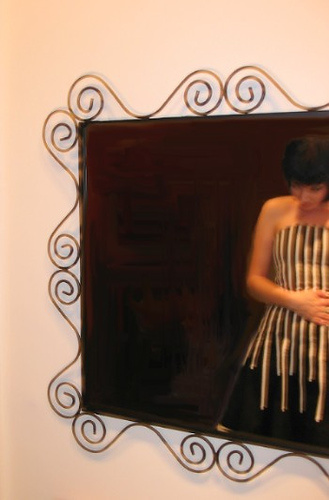
Hating our bodies is a great handle for marketers to grab onto–which is why I see body hatred as a corporate ‘sin’ as much as an individual one. Untold billions are made off of people’s hatred of their bodies.

Body hatred might be regarded as a form of ingratitude for the life and body God has given us. It may lead us to fulfill certain desires in ways God doesn’t intend (for example, self-starvation or gluttony.) It may lead us to covet what we don’t have–as when we look at someone else’s body and wish we looked “like that.”

As always, the ultimate remedy is the grace of God shown to us in Jesus. I think of the communion table as a place of grace and healing in particular for this ill.  Supplementary remedies include:

  • Love & Gratitude

Give thanks for your body and for your life! If you’re reading this, chances are that you’re breathing. Start with giving thanks for that breath. And the next one. And so on.

  • Be Extra-Kind to your body–enjoy your body!

Loving your neighbor “as yourself” presupposes that you love yourself. Eat well. Sleep enough. Move some. Put lotion on your dry skin. Dress so that you are comfortable and confident. Doesn’t mean endless primping. I’m talking about making the time to treat your body as well as you would treat the body of someone you really love.

  • Starve the Beast!

Interrupt the cultural messages that encourage you to think there’s something wrong with YOU, instead of with the airbrushed images of anorexic people they present as ideal.

Answer the inner voice back if it’s telling you that you’re ugly, too thin, too fat, too jiggly, whatever.

Remind yourself that you are God’s handiwork.

For me, starving the beast means I don’t look at certain catalogs or magazines or shows. Do you need to cancel certain subscriptions? Stop watching certain movies?

  • Prayer and Meditation

Ask God for mercy and help to see yourself and others as God sees them.

  • Find Support

If you suspect that you may need professional help for an eating disorder or for a body image disorder, please get help. You can even contact me if you need help looking for a professional in your area.

But even if your problem does not warrant the care of a mental health professional, it is a good idea to find support in a friend or confessor who has a healthy body image and can encourage you to embrace yourself as God made you.

What has helped you accept your body? What has stood in the way?

Why and How to Minister with Meals

Why and How to Minister with Meals

I’ve written a number of times about bringing a home-cooked meals to people.

It’s a time-honored tradition, one my family and I benefited from richly following the birth of our second son in St. Andrews, Scotland. When there are new babies, or when there is illness or death, bringing a meal, far from being a mere symbolic gesture, does at least 2 things:

1. It lets the person/family off the hook from planning/shopping/preparing dinner.

2. It lets them know that they are not doing this “thing” (cancer, grieving, new parenthood) alone.

{These observations are from my friend Ellen’s post this week–she learned firsthand the power of meals when she had cancer and she and her family were fed for 8 weeks by friends, acquaintances, and a few people they’d never even met!

“And it suddenly made sense, this impulse to feed people who are going through something life-altering.”

Recently I became aware of a nifty website that aims to facilitate such sharing of meals. It’s called MealTrain.com, and it’s an easy way to organize meals for someone. It’s free, you can put the word out via email and/or Facebook, and it allows you to note the receiving family’s preferences and/or allergies as well as to indicate what you plan to bring (so that the new family doesn’t end up with lasagna–or whatever–4 nights in a row.)

And it’s free!

Meals are a great way to communicate love and care in a variety of circumstances–

  • when a new family moves into a community
  • when there is a death
  • when someone is ill, injured, or hospitalized
  • when someone has had a miscarriage, or during a difficult pregnancy
  • when there is a new baby
  • when someone’s spouse has been recently deployed

Maybe you can think of more reasons. Whatever the reasons, a meal given to someone is a means of grace made edible. I don’t want to go all preachy on you, so I’ll just say this: think of a time when you were so tired, or sad, or overwhelmed, or lonely, and cooking dinner was really the last thing you wanted to have to worry about. Imagine what it would’ve meant to have a friendly face show up with a meal made especially for you.

What have been your experiences of giving and receiving meals? Have you used MealTrain?

(Just to be clear–I’m writing about Meal Train because I like what they’re doing, not because I’m receiving anything for doing so!)

Why McDonald’s in France Doesn’t ‘Feel’ Like Fast Food

Why McDonald’s in France Doesn’t ‘Feel’ Like Fast Food

No, I never set foot in a McDonald’s in Europe, except for one, desperate day in Dundee, Scotland, where my friend Julia and I escaped the damp cold with our husbands to eat McDonald’s “local” specialty, the Cadbury Creme Egg McFlurry, all other ice-cream-like options (I think we were actually aiming for Thornton’s ice cream?) being closed.

Before you go getting all jealous, I’ll assure you that it wasn’t nearly as glamorous as it sounds.

Anyway–for your weekend reading pleasure, I present (HT Ellen!) Eleanor Beardsley‘s NPR piece on Why McDonald’s [MacDo, they call it] Doesn’t Feel Like Fast Food.

{Spoilers: Among other things, the restaurants are nicer for sitting and relaxing in, and the food is better quality.}

I’m no longer posting on Sundays. Enjoy the weekend, and I’ll see you on Monday!

Pregnancy as Hospitality

Pregnancy as Hospitality

NYMag’s Vulture blog had this post on how the movie posters from the What to Expect When You’re Expecting movie are “deeply disturbing.” And they are, look–

And that’s one of the less-bad ones.

What’s frightening about these photos is how ridiculously skinny and airbrushed these pregnant women are, like the pregnancy is some kind of abdominal accessory.

Make no mistake, “skinny pregnant” is a thing. I get blog hits every day based on those kinds of search terms. When I was first pregnant, I read, with great interest, this article about pregnant New Yorkers who worked out like crazy and counted every ounce. I learned of this exercise program aimed at preventing and reversing the “mummy tummy.” And I also found the oddly titled Pregnancy Without Pounds.

Because, I’m ashamed to say, I was afraid of getting bigger.

A number of times now, I’ve been asked how I went from disordered in my eating and body image to joyfully (if occasionally) consuming pie for breakfast.

I’m never quite sure how to answer the question. It’s complicated.

But there is one thing that I can point to for sure. Wait, two things, actually:

Oh, I didn’t start out well. I fretted about getting a belly (will it ever go away?) and confessed to my husband that I “just didn’t want to gain weight.” And he said:

“If you don’t gain weight, our baby will die.”

{Ouch.}

And so I did the best I could. I ate. (And managed not to puke it all up.) I got bigger. And I had a really, really beautiful baby. I nursed him. And as I nursed him, I felt a powerfully strong sense of our connection. To feed him, I had to feed myself. I wanted him to get bigger and stronger. I had a context for seeing feeding and weight gain as unquestioned positives, and to make that happen, I had to feed myself so I could feed him.

Having my baby showed me my unmistakeable connectedness.

To me, that’s the thing that’s scary about the obsession with pregnancy skinniness, which I see reinforced everywhere–on Facebook, in conversations, and (certainly) among the tabloids, which seem always to be screaming about how skinny this or that celebrity just X number of weeks after having a baby, and now, these stupid movie posters.

The obsession with pregnancy skinniness spectacularly misses the point, which is that women’s bodies are capable of

making room.

hosting new life.

welcoming babies, those nearest of strangers.

I just want to be at OUR table…

I just want to be at OUR table…

While in the magical disembodied world that is the Internet, I have appeared to be where I always am, in fact, my family and I have been in Harrisburg, Pennsylvania for more than a week. We’re getting ready to leave, and while we have had a wonderful time with friends both new and old, we are feeling ready to get back to our home (and our cats.)

(After a stop at the Harrisburg branch of the Appalachian Brewing Company, of course.)

My older son (Aidan, age 6) reminded me of the centrality of the table to what it means to be a family in a home. He’s not much for homesickness, or at least for openly expressing it, but today he asked if we’d be back tonight in time for dinner.

When I said I wasn’t sure, his eyes filled quickly with tears, which he tried to hide, and he bravely said,

“I just really wanted to eat dinner at our table again. I miss our table.

Yes, my son–that longing for the table–our table–is built into you from the beginning. It is a picture of the longing we all have for belonging at a great table with all our beloveds, where we are ourselves are beloved, and where grace and plenty abound.

Aidan and his Grandpa at 'our table.' "Prost!"

That’s why, as the French say, “the table comes first” (when purchasing furniture as newlyweds.)

That’s why, as Robert Farrar Capon says, the table–or board–is one of marriage’s two essential pieces of real estate.

(The other being bed, of course.)

And so we’re headed back to our table.

{Wishing you grace, peace, and love around your table, friends!}

Discovering Hugo (and you.)

Discovering Hugo (and you.)

Usually I really don’t care what movies are nominated for/win Oscars unless its so that I can scoff that the Academy is full of nonsense and that their choices just stink.

At the same time, though, a nomination usually means that the film will be seen by more people. And I certainly hope that will be the case for Hugo.

Hugo in the Toy Shop

I was first introduced to the story by my son, who loves Brian Selznick’s The Invention of Hugo Cabret–a unique novel “in words and pictures,” upon which the film is based. More than illustrations, the pictures that make up more than half the bulk of the book wordlessly advance the plot–an homage, of sorts, to the silent films that play an important role of their own in the story. Perhaps this is one of the reasons that Hugo was a better-than-usual book-to-film adaptation–there was something of film within the book already.

The film was not disappointing at all–and I’m delighted that was able to see it on the big screen, where it comes alive under Scorcese’s able direction, Robert Richardson’s stunning cinematography, and Howard Shore’s (of Lord of the Rings fame) haunting and beautiful score. (All three were nominated for Oscars for their respective contributions, and the film was nominated for Best Picture.)

Hugo is also surprisingly, richly theological in some surprisingly Christian ways. I hate reviews that give away substantive facts, but suffice it to say, it is about creativity, it is about vocation, about redemption and grace in the unlikeliest of circumstances. It is about communicating, reconciling, remembering, community-forming love.

All without being the least bit ‘preachy.’

So I’ll be preachy, just for a second: go see Hugo!

And if you’ve seen it/read it, please do share your thoughts below!

These are a Few of Life’s Crappiest Things! (Reading Ecclesiastes)

These are a Few of Life’s Crappiest Things! (Reading Ecclesiastes)

Did you know that this blog got its name more-or-less straight out of a Bible verse?

Don’t feel bad if you didn’t catch that; it comes from Ecclesiastes, which, being a frequently-neglected book of the Bible, is, naturally, one of my favorite books. (I enjoy rooting for underdogs.)

While some writers and preachers like to say that Ecclesiastes is all about how bleak life is without Jesus, it seems to me that the little book pretty well sums up many of the crappiest things about life:

1. Where there ought to be justice and righteousness, there’s injustice and wickedness.

2. Even if you’re strong, beautiful, brave, ambitious, and rich, you’re going to get painfully feeble and old, and, eventually, you’ll die. And, by the way, you can’t take all your stuff and money with you.

3. Everything people do can, much of the time, be chalked up to pride and competitiveness.

4. Rich people just can’t ever get enough money. They always want more.

5. It’s not the most deserving, or strongest, or wisest, or most knowledgeable people that get the recognition. Time and chance have everything to do with that.

6. More knowledge is usually a depressing thing.

So, yeah. Any of these could’ve come from a blog post or op-ed written, well, yesterday, but they’re from this funny little Ancient Near Eastern book that’s part of the Hebrew Bible and Christian Scripture.

By now you’re wondering what all this has to do with the title of this blog. Well, there’s this refrain (of sorts) throughout Ecclesiastes that goes something like this:

There is nothing better for a person than that she should eat and drink and find enjoyment in her work. This is from the hand of God,  for apart from God, who can eat or have enjoyment?

Because here’s the thing about eating: obviously it’s not the most important thing in the world–aren’t things like doing justice, working hard, loving God, loving neighbor, taking care of your family much more important?

Well yes. And no. Because if you don’t eat, you can’t really do anything else. It’s easy to miss this in an overfed culture, but “give us this day our daily bread” is talking about the literal stuff that keeps you alive & kickin’.

Yes, life is marked with death and sadness and injustice and unfairness and depression and general crappitude.

Yet. Yet–

This world is still a beautiful place; there “lives the dearest freshness deep down [in] things.” There is love, there is laughter, there is community, communion, companions–there is the joyful, jovial fellowship around the table and thousands of things to delight our senses.

And food is one of them, a delightful necessity. A chance to nourish others, to be nourished ourselves, and to taste just a hint of God’s goodness.

So, yes. Death and greed and decrepitude and turpitude and all manner of crappiness. And still the ancient Preacher says:

“Go, eat your bread with joy, and drink your wine with a merry heart.”

Yes. Life is more than food. But in this life where little makes sense, food and wine are a spot of grace and goodness—

God’s love made edible. And delicious.

Moment by moment, sustaining us by grace.

spare me words like “homegoing,” “graduation,” or “life celebration”

spare me words like “homegoing,” “graduation,” or “life celebration”

If you have been reading Eat With Joy for a while you’ll know of my fondness for two very old friends of mine, whom I’ve referred to here as Mr. and Mrs. S.

That’s them on their wedding day in 1949–after Edie (Mrs. S.) had served as an Army nurse on a psychiatric unit and after Jack (Mr. S.) had spent nearly four years in military hospitals following a serious injury sustained to his leg on Iwo Jima.

{They were married in the Episcopal church, a three minute walk from my home, and I was always amused when Jack got to the part in the story of their wedding where the rector asked them to kneel. His leg had fused into one long bone–no knee–after his injury, and so he couldn’t kneel. “Can’t kneel,” he said. So they just skipped that bit.}

There is so much I could say about these people. About their kindness and courage and virtue. About how my parents loved them as if they were their own parents; about how they were grandparents to me from the time I was 7. About how my tiny son, undaunted by Jack’s blindness and skin afflictions, climbed up to plant a big kiss on his lips during one of our Saturday breakfasts (which later turned into Saturday dinners.)

About how two weeks from now will mark 92 years since his birth.

And about how, on Friday, he died in the nursing home, holding Edie’s hand.

This kind of death–when a person is very old, when they’ve been very sick and in great pain, when they share our faith and belief in the resurrection of the dead–this kind of death is sometimes shrugged off:

“At least they’re not suffering.”

“He had a good, long life.”

“We will see him again.”

Even when such observations express some truth, they irk me for the following reasons:

1. Death is an enemy, not a friend

Don’t know about you, but I’ve attended too many Christian funerals that leapfrogged over the horror of death to get to the promise of the resurrection. (“I’m happy for brother so and so that he’s with Jesus!”)

Have you noticed that in these contexts, old, sturdy, and thoroughly appropriate words like “death” and “funeral” are conveniently left out in favor of “passed away,” “went to be with the Lord,” “homegoing,” and (my most-hated) “graduation”?

Sorry, but even a tradition that holds fast to the hope of the resurrection shouldn’t shy away from calling death what it is–what the Bible calls it, for goodness’ sake–an enemy, an evil, a wicked and grievous thing.

2. Grieving a death thoroughly is not un-Christian

I have never had the chance to be at a funeral that was primarily attended by people of African-American heritage, but I’m told that keeningcrying out and wailing–is an important part of the funeral in this tradition, and this sounds good to me. It isn’t “grieving without hope.” It isn’t denying the resurrection. It’s a practice that gives full outward expression to grief–”real emotions in real time,” as my dad puts it–and that’s a healthy thing. Where on earth did we get the notion that the ‘Christian’ thing to do is put on a happy face for funerals (excuse me, “homegoings”) and pretend like it’s no big deal, ’cause we’ll catch up with ‘ol Jack at the End of All Things? 

3. Losing people you love hurts.

Doesn’t matter if they were old, or sick, or in pain; if the death was peaceful, painless, expected. Death ends our ability to commune with our beloved ones, and trusting in the promise of Resurrection doesn’t erase that loss–they have still gone, as Shakespeare wrote, to that “undiscovered country from whose bourn [border] no traveler returns.”

Plus, love doesn’t listen to stupid reasons.

I keep thinking of this interview I heard with Jean Vanier, who helped found the L’Arche communities. He tells of a woman who was severely disabled–blind, unable to speak, incontinent, needing to be fed, dressed, everything. And she had been a part of their community for 30 years and was in her 70s. One day a woman visited the house and asked:

” ‘Oh, what is the point of keeping Françoise alive?’ And the leader of the little house said, ‘But madam, I love her.‘ “

And I loved Jack. So I will mourn, not without hope, but still I will mourn.

What about you? What place does mourning and grief have in your experiences of faith and life–and death?

Swift to its close ebbs out life’s little day;
earth’s joys grow dim; its glories pass away;
change and decay in all around I see;
O thou who changest not, abide with me.

Using God as Backup for White Middle Class Standards of Beauty

Using God as Backup for White Middle Class Standards of Beauty

Usually for your weekend reading I post something of interest from around the web. This week I enjoyed reading the HuffPo listing of the 10 most polarizing foods–foods that people either love or hate–but some of your responses to this weeks’ earlier posts made me think you might enjoy this one, originally posted in August, on using God as backup for enforcing white middle-class standards of beauty and grooming.

Recently I read back through just a bit of Disciplines of the Beautiful Woman by Anne Ortlund–because I vaguely remembered that there was something in there that had once had a grip on my mind–and I only had to suffer through 43 pages until I found it:

“..my advice to all is: when you first become conscious in the morning, get decent. I know some people say [pray] first, but don’t you sort of feel sorry for God when daily he has to face all those millions of hair curlers and old robes? What if you were the Almighty, and got prayed to with words spoken through all those unbrushed teeth? It seems to me like the ultimate test of grace.”

(Hm, so I should have compassion on God and look good before I pray?)

She goes on to pose a number of questions like these:

“How are your hips, thighs, tummy?”

“Do you need to get into that jogging suit and run?”

“How is your hair?”

“What kind of program are you on to stretch, bend, and stay supple, to stand tall; to be a good advertisement of God’s wonderful care of his children?”

(So I have to look good not only for God but for everyone else, too?)

From about age 15 or so, I used to get up early to use the NordicTrack or to do some idiotic aerobics routine before school, for 2 reasons:

1. I didn’t think I deserved to eat breakfast until I’d exercised

and

2. I didn’t think God wanted to hear from me unless I was ‘disciplined’ enough to exercise regularly.

Being a typical American teenager, it didn’t even occur to me that God might have bigger things to worry about than whether I reached my target heart rate or ate too many grams of saturated fat. I’m pretty sure 1996 had enough injustice, war, natural disaster, famine, and other stuff going on that God wouldn’t have minded hearing the prayers through unbrushed teeth or from girls who chose to do something with their spare time besides fitness and beauty maintenance.

surely I’m not the only one who had a caboodle?


I’m pretty sure that somewhere, deep down, I knew that God didn’t care what I looked like. Nonetheless, pleasing God by looking good was bound up in my mind and body with actually doing good in the world.

In The Beauty Myth, Naomi Wolf argues that the pressure on women to attain to an unrealistic standard of beauty has  increased along with women’s freedoms in other areas of society. A study of archived letters from students at Smith College suggests that women before suffrage (1920) were more likely to worry about needing to GAIN weight, while women after, almost universally, worried about needing to LOSE weight.

{Why? To take up less space? To look better in the ‘flapper’ style? To eschew feminine curves for a more androgynous appearance?}

This problem, it’s not unlike my Audrey Hepburn problem. But it’s worse in some ways, too, because claims like Anne Ortlund’s use God as backup for enforcing white middle-class standards of beauty and grooming.

And her book isn’t the only one to do that. Lots of the ‘Christian’ diet books out there do the same thing. And that’s what had me so upset about the article in Relevant last week.

Because what’s good? And what does God want from us?

{100 sit-ups and 100 push-ups every morning? Detoxification ‘cleanses’?}

NO–

To do justice.

To love mercy.

To walk humbly with God.

{I’m no longer posting on Sundays. See you all on Monday!}

How Patriarchy Gave Me an Eating Disorder, Part 2

How Patriarchy Gave Me an Eating Disorder, Part 2

My husband says I forgot to point out that not only did Ruth pursue Boaz, pretty much proposing marriage to him, but she also went and lay down next to Boaz at night. When he was sleeping. After he’d been drinking.

How’s that for some ‘Biblical’ Passion & Purity!?

{And yes. I totally love and adore my scholarly husband for pointing that out.}

Anyway, OK. Brief recap from part one–

Things I learned from evangelical culture:

Be Pure.

And so be afraid of your own desires.

Be Pretty.

And so be afraid of eating, excreting, and everything bodily.

Be Perfect.

And so walk the fine line between looking great, being ‘nice,’ and pretending that you don’t even care about ‘the physical.’

{Because you have a crush on the cute boy with nice hair who plays guitar for youth group talks piously about wanting to date only ‘spiritual’ girls. And ‘spiritual,’ in the theology of the evangelical youth group, means ‘not physical.’ That’s why the really ‘spiritual’ girls are always ‘dating Jesus.’ Which unfortunately translates, too often, treating the smitten guys around them, with whom they’re ‘just friends,’ like crap.}

My own understanding of growing up Christian, then, meant shutting down everything that was God-given, normal, and healthy.

I was terrified of ‘liking’ boys because that might lead “someplace” sinful. So I was choked up, found it hard to talk to boys unless it was to listen to how much they liked my friends.

I was terrified of getting a womanly body. Not just because women were dangerous temptresses, all curves and sensuousness and endangering to a young man’s ‘purity,’ though that was part of it.

Part of it, too, was that I was afraid to take up space. Because, after all, in the evangelical version of womanhood I’d pieced together for myself, a woman’s passive perfection entailed unobtrusiveness.

Let me tell you, I’m not really naturally unobtrusive. Oh, I might be a little shy when we first meet in person. And I’m told my personality is more ‘sweet’ than not. But I also can be a bit of a Scrappy Doo, or, if you prefer, a bit of an Anne of Green Gables kind of girl. One time I smacked a boy in my Sunday School class on the head with a hardback Bible. (Sorry about that, Tommy!) I rather enjoyed debates as a young’un. And none of that’s really conducive to the whole “gentle and quiet spirit” thing that I took to mean passivity.

Somehow, in my mind, cultivating a passive, pure, perfect Christian girl persona got tied in with remaining physically petite. Not being ‘weighty,’ not being a contender. Something to be pursued, not someone to be reckoned with.

And then, too, there was the food side of things. Oh, food. Until a certain point–I think about age 14 or 15–I enjoyed eating and didn’t give undue thought either to food or to my weight. Sure, I was aware of dieting, aware that ‘someday,’ when I was a woman, I’d hate my body just like most of the grown-up women I knew. But I liked food. Not that I was particularly adventurous, but I remember relishing the sweet and sour chicken my dad would cook for my every birthday at my request, the simple pleasure of perfectly steamed white rice, and the lemony explosion of a cold Granny Smith apple behind my teeth.

Somehow, though–and it’s all mixed in, I think, with the passivity and the perfection, the prettiness and the purity–I began to fear my appetite. Just when my appetite should’ve been growing–when I was growing, both in mind and body, more rapidly than I’d ever grown since babyhood–I recoiled from it in fear.

Gluttony was a sin, after all. The body’s desires were suspiciously sinful: “put a knife to your throat if you’re given to gluttony”?!

You combine that with a food culture like ours, where food is plentiful, cheap, and everywhere, and I began to harbor a secret, shameful fear: what if I eat everything? What if I just start eating and can’t stop? If I can never stop? How would I know how to stop?

Obviously, eating was too complicated and dangerous.

Not eating was easier. Of course, then the problem was my hunger would overtake me, eventually, and I’d break down and eat and eat, always, it seemed, too much–enough to trigger fear, panic, guilt; terror over letting my physical ‘desire’ get the better of me.

After all, where might that lead?

And so I was afraid: afraid of wanting to eat, of eating, of liking boys, of boys, of accepting my body, of my body, of going out and of being seen.

I would get dressed under my bath towel, hiding nakedness from myself.

And in all this time, all this was a shameful secret.

Because, after all, this wasn’t the behavior of someone pretty, perfect, pure, or passive.

But that–a tortured, circumscribed, turned-in-itself, endlessly abstemious life–is not the flourishing, fully human life God desires for God’s daughters.

You are God’s. God made you, you are beautiful, and God loves to feed you and to see you flourish–you, as God made you–not you, pressed down and rolled out and cut to fit some other shape.

You, as God made you, are beautiful.

{of course this isn’t the end. there’s more to my story. and to yours. looking forward to sharing and hearing more…}